Road safety directly impacts insurance premiums, liability exposure, and infrastructure spending across the U.S.—yet fatality rates resisted improvement for years. The automotive industry faced regulatory pressure over annual deaths, spurring advances in vehicle safety features. Road design also shifted, with changes to intersections and street layouts showing measurable impact. But the real question is whether those efforts are actually working.
New traffic data from the National Highway Traffic Safety Administration and the U.S. Department of Transportation reveals they are. Recent studies show a clear downward trend in fatalities. Technology embedded in vehicles, autonomous systems coming online, and smarter road infrastructure are all factors that are impacting road safety. Triumph Law Group, a personal injury law firm in Phoenix, unpacks what the data actually shows and where the safety improvements are coming from.
Road Accident Statistics Unpacked
Annual figures on traffic safety are produced by the NHTSA and DOT. While the driving data for 2025 is still a statistical projection rather than containing final, firm numbers, the trend toward fewer fatalities is clear. Specifically, it’s estimated that deaths from auto collisions fell 6.7% year on year, from just over 39,000 in 2024 to 36,640 last year.
Q4 of 2025 was the 15th consecutive quarter in which a decline in fatalities was recorded, and researchers are confident that this trend represents a rebalancing of road safety following the unexpected disruption associated with the pandemic. So, while we’re not yet at historic lows, there’s clear, continuous movement in the right direction.
To further cement the improving safety conditions, the report estimates that for every 100 million vehicle miles traveled (VMT) on U.S. roads, just 1.10 fatalities occur. That’s a decline from the 1.19 fatalities per 100 million VMT calculated in 2024. Only one other year in the history of recording traffic safety statistics has had a lower average number of fatalities per 100 million VMT.
The data shows fatality reductions across all regions of the U.S.—even in areas that historically had higher rates. The East Coast saw the largest estimated reductions in fatalities, with areas including Virginia, Kentucky, Washington D.C., and North Carolina even reaching double digits.
The downtrend in road fatalities does not mean there isn’t a need for further improvement.
Technology’s Influence
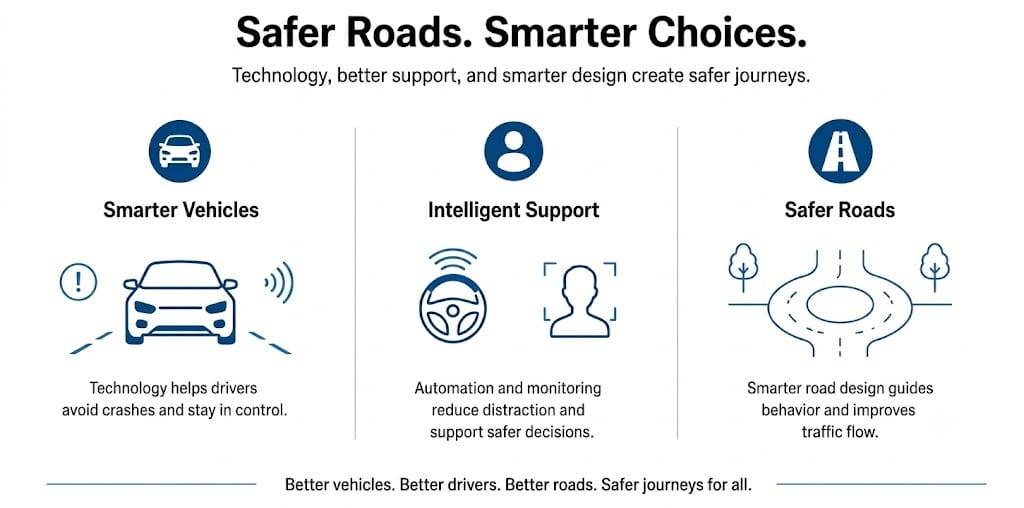
Mandatory safety tech is part of the story. Tighter vehicle regulations forced automakers to add features that actually prevent crashes. We’re entering a period in which true self-driving cars are a reality in more parts of the country, bringing the potential for even further risk reductions.
Advanced driver assistance systems (ADAS) are now standard in most new vehicles. They range from general aid to direct intervention without taking total control of moment-to-moment driving away from a human. This includes autonomous emergency braking, lane keep assist, and automatic speed limit detection, to name but a few. As indicated in a 2024 survey conducted by the Insurance Institute for Highway Safety, 60% of motorists have no problem with vehicles issuing audio alerts and visual warnings on the dashboard when they exceed the speed limit.
Drivers most likely to speed were also most resistant to in-car speed limiters. If ADAS can keep responsible drivers safer with these reminders and minor interventions, that’s better for the majority of road users.
Automation and Further Driver Monitoring
Waymo’s autonomous vehicle testing shows real safety gains. The data: 0.6 injury-involved collisions per million miles for autonomous vehicles, versus 2.8 for human drivers. Research found that, on average, 0.6 collision incidents with an injury were reported per million miles driven in an autonomous test vehicle. When human drivers are assessed, the number is 2.8 injury incidents, making self-driving vehicles 80% less likely to be involved in serious collisions.
Driver state monitoring (DSM) technology offers another layer of intervention. Made up of cameras and sensors that track fatigue and distraction, DSM systems could prevent the two biggest behavioral causes of collisions.
Research from TRL and the DVSA points out that 20% of vehicle collisions in the U.S. stem from an overtired person being behind the wheel, while 8% of fatal crashes list distraction as a contributing factor. It also cites a potential 93% drop in fatigue-related incidents and over two-thirds of distraction-related collisions, made possible when vehicles are fitted with DSM systems.
Safer Road Design and Infrastructure

Road design and infrastructural changes are the third factor reshaping safety outcomes. A University of Michigan study examining 2019-2023 data tracked what happened when roundabouts replaced traditional intersections across various counties.
The findings show that roundabouts result in fewer serious collisions because their design inherently encourages drivers to be more engaged and aware of the road rules, with motorists self-enforcing these rules rather than relying on lights and signals. Researchers found that roundabouts have a positive impact in low-income communities, where behavior-related crashes fall post-installation, even if there’s a slight uptick in minor crashes as the community gets to grips with how this type of road feature works.
Changing the physical shape of our roads is sometimes more effective than posting a speed limit sign. This level of self-enforcing design goes hand in hand with the discussion of ADAS and DSM, since it’s about encouraging greater driver involvement and accountability. All these points to the likelihood that the driving data for 2026 and beyond will show further declines in traffic incidents and across-the-board improvements in road safety.
By Triumph Curiel for Triumph Law Group.


T